Obelisk Headstones: Styles, History, and What Affects the Price
August 16, 2026 • Clear Stream Monuments • 8 min read
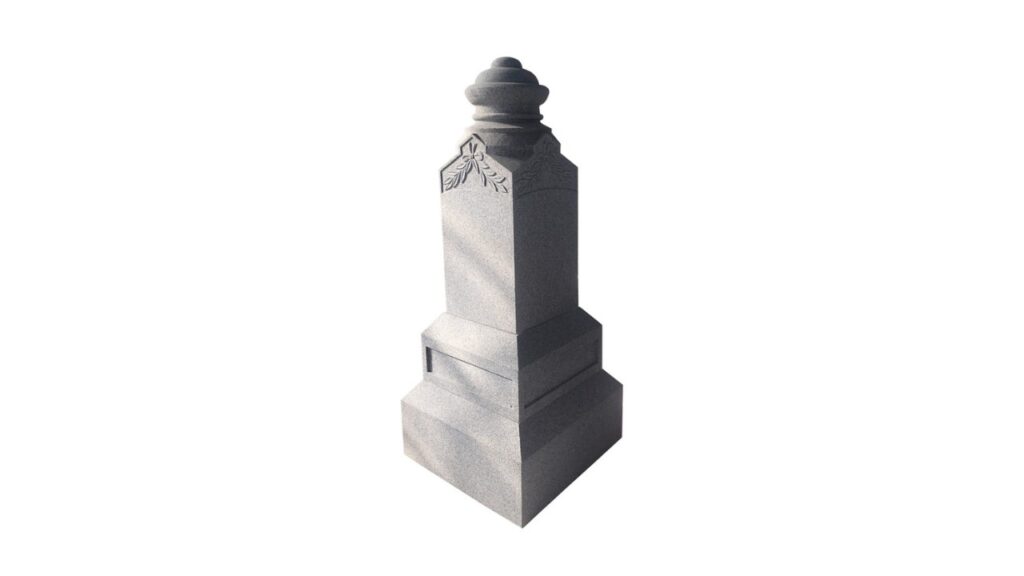
An obelisk headstone is one of the more recognizable memorial shapes in a cemetery: a tall, four-sided pillar that tapers as it rises, usually set on a wider base. Families researching the style are often weighing it against a standard upright marker, and two questions tend to come up early: what the shape is actually associated with, and what makes a monument this size cost more or less than another. Both are worth answering before settling on a design.
What Is an Obelisk Headstone?
An obelisk is a narrow, tapered pillar, wider at the base than at the top, usually finished with a pointed, domed, or stepped crown. In ancient Egypt, an obelisk was carved from a single block of stone. Modern memorial obelisks are typically built in sections instead: a shaped pillar set on a sub-base and a wider foundation base, which gives installers more control over stability on a monument that can stand five or six feet tall.
Because of that height, an obelisk reads differently in a cemetery than a flat marker or a standard upright headstone. It’s chosen specifically for visibility and vertical presence. That’s also why cemetery height rules matter more here than they do for shorter memorial styles, a point covered in more detail below.
Where the Obelisk Form Comes From
The shape itself is ancient. According to the World History Encyclopedia, the ancient Egyptians began creating obelisks during the Early Dynastic Period, roughly 3150 to 2613 BCE, carving them from monolithic red granite and raising them in pairs at temple entrances. Each side was typically carved with hieroglyphs honoring a deity or ruler, and the pillars were positioned so that the first and last light of day would touch their peaks.
The shape didn’t arrive in Western cemeteries until much later. Napoleon’s Egyptian campaign in 1798–99 produced a wave of publications on Egyptian art and architecture, and the resulting interest, often called the Egyptian Revival, worked its way into 19th-century design, including memorial architecture. According to the Cedar Hill Cemetery Foundation, the obelisk became one of the most common Egyptian Revival forms in Victorian-era cemeteries, appearing in burial grounds across Britain and the United States through the second half of the 1800s.
What the Shape Has Come to Represent
To the ancient Egyptians, the obelisk carried a specific religious meaning tied to solar worship and the sun god Ra. That’s a documented historical association, not a claim about what the shape means universally today. When Victorian cemeteries adopted the form generations later, it was reinterpreted through a different lens: the Cedar Hill Cemetery Foundation notes it came to represent eternal life or a ray of sunlight in that funerary context, and some Christian communities read it as a symbol connecting earth and heaven.
Neither reading is the “correct” one, and a family choosing an obelisk today isn’t bound by either. Some are drawn to the history, some simply to the height and presence of the form, and some to the practical reasons it became popular in the first place. It was a monument that could stand out in a relatively narrow plot without the cost of a large sculpted statue, which is part of why cemeteries filled up with them through the late 1800s.
Obelisk Styles Available Today
Clear Stream’s obelisk designs range from a plain tapered form to versions with carved detail, and they fall roughly into three groups.
Classic and unadorned. The Fancy Obelisk is the simplest of the group: a tall, tapered pillar with a pointed top and no carved motif, standing 72 inches overall and available in gray, black, or black pepper granite. It’s the version to look at if the height and shape are the draw, rather than a specific carved symbol.
Architectural crown details. The Dome Top Obelisk softens the traditional point into a rounded crown with carved accents around a clear inscription panel, at 58 inches overall. The Double Roof Top Obelisk takes the opposite approach, adding a stepped, layered rooftop detail for a more architectural silhouette, at 62 inches in gray granite.
Carved and symbolic detail. The Leaf Top Obelisk adds raised leaf carvings across all four sides of a pointed-top pillar, at 70 inches in gray or black. A separate design with the same carved detail, built for cremation memorialization with built-in niche capacity, is also available. The Roof Top with Cross Obelisk Headstone and the Roof Top Obelisk with Weeping Flower both use a shorter roof-top pillar, at 52 inches, with a sculpted cross or a sculpted broken-flower carving set into a recessed front panel. The cross reads as a religious marker; the flower reads as a more general symbol of remembrance and loss.
Across these six designs, overall height runs from about four and a half feet to six feet, considerably taller than a standard upright headstone. That difference is the main thing to plan around, both visually and for cemetery approval.
What Affects the Cost of an Obelisk Memorial
Search interest in obelisk pricing is high, and for good reason: a monument this size involves more variables than a flat marker. Clear Stream doesn’t publish blanket pricing here, since the right combination of size, stone, and detail is different for every family, but the factors that generally move the price are consistent:
- Size and height. More granite means more material and more shaping time. The six-foot designs above require substantially more stone than a two-foot flat marker.
- Granite color. Some colors are more readily available than others, which affects both material cost and finishing time.
- Carved detail. A plain tapered form like the Fancy Obelisk requires less hand-finishing than a piece with raised carving on all four sides or a sculpted recessed panel, like the Leaf Top or Roof Top designs.
- Foundation and installation. A monument standing four to six feet tall needs a properly sized foundation to stay upright and level, and installation at this scale is typically handled by professionals rather than a simple placement.
- Cemetery-specific requirements. Some cemeteries charge separately for foundation work or require documentation before approving a monument of this height, which is worth asking about before you’re set on a design.
Granite headstone pricing generally breaks down into the stone and carving, the base and foundation, and delivery and installation. What’s typically included in a headstone purchase is worth reading before comparing quotes, since some providers price foundation work as a separate line item rather than bundling it in.
Cemetery Rules and Height Considerations
Because obelisks run taller than most upright headstones, it’s worth confirming height and footprint limits with the cemetery before getting attached to a specific design. Many cemeteries cap monument height by section. Older or historic areas are sometimes more permissive than newer memorial gardens, which frequently restrict everything to flat markers regardless of style. The size and foundation requirements a cemetery typically specifies can rule out an obelisk in certain sections even where upright monuments are otherwise permitted, so it’s worth checking before finalizing anything.
Choosing the Right Obelisk Memorial
A few practical questions help narrow the decision once the history and cost factors are clear:
- Does the cemetery section allow a monument this tall, and is there a documented height limit?
- Is a plain tapered form enough, or does the family want carved detail, such as a leaf motif, a religious symbol, or a floral design?
- Which granite color fits both personal preference and what’s already standing nearby in the cemetery?
- Will the inscription need to accommodate more than one name, and does the chosen design leave enough clear surface for that?
For carved detail beyond what’s shown here, such as a specific symbol, a family crest, or custom lettering, the design and proofing process for a fully custom headstone follows the same general steps regardless of the base shape. If granite color is the open question, the range of granite colors quarried in Georgia covers options beyond the classic gray shown on most of the designs above.
Conclusion
An obelisk headstone carries a specific history: Egyptian in origin, later adopted into Western cemeteries through the 19th-century Egyptian Revival. The reasons families choose one today are usually more practical, centered on the height, the presence, and a shape that stands apart from a standard upright marker. Confirming cemetery height rules early and understanding what drives the cost of a monument this size will save time once you’ve settled on a style. For more on choosing a design that fits your family’s preferences, browse Clear Stream’s other design and personalization articles, or reach out to Clear Stream Monuments to talk through options for your family.